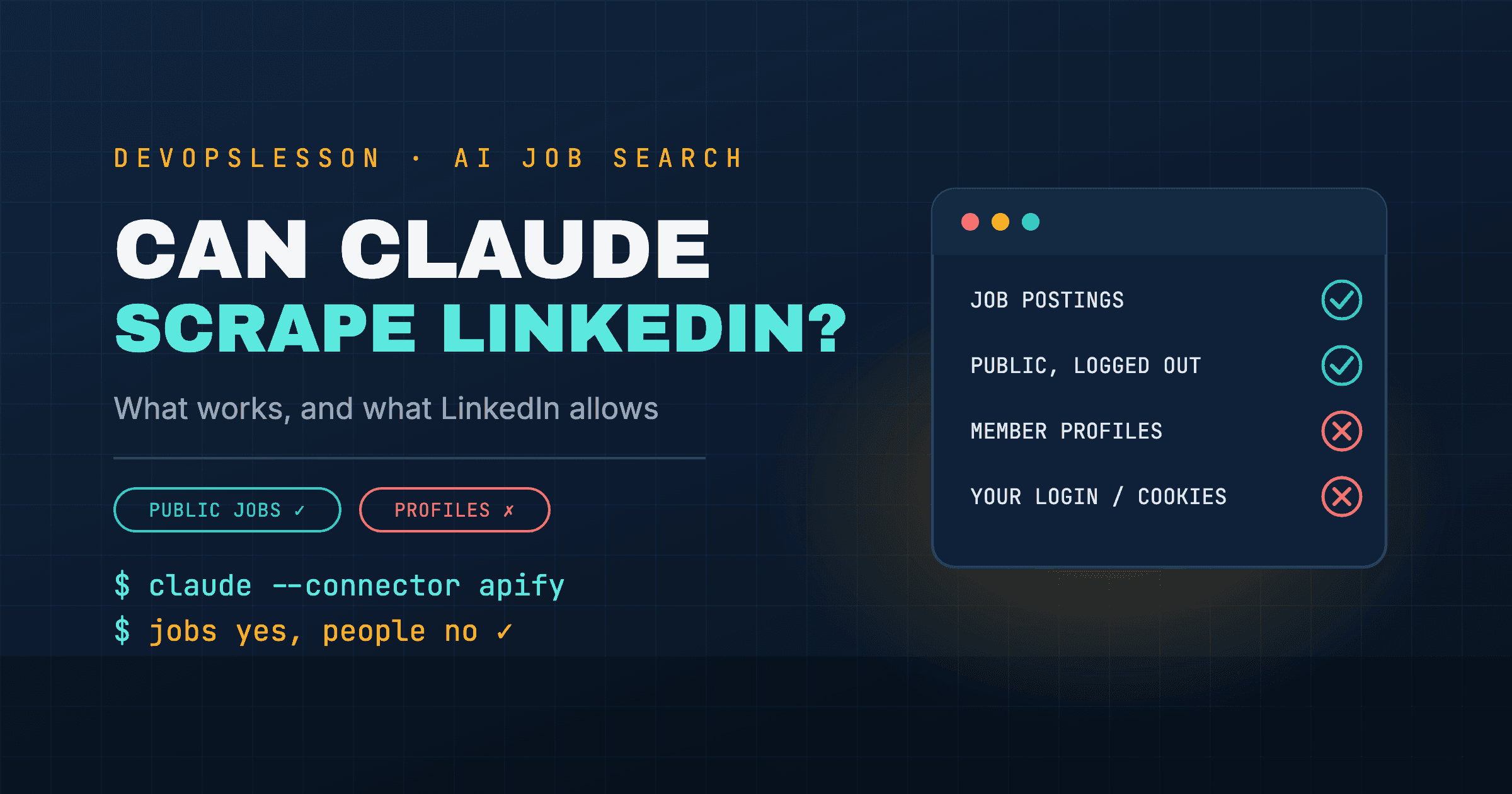
Short answer: not by itself. Claude has no LinkedIn login, and LinkedIn blocks most automated traffic, so asking Claude to "go on LinkedIn" in a plain chat gets you a polite refusal or a summary of whatever its web search can see.
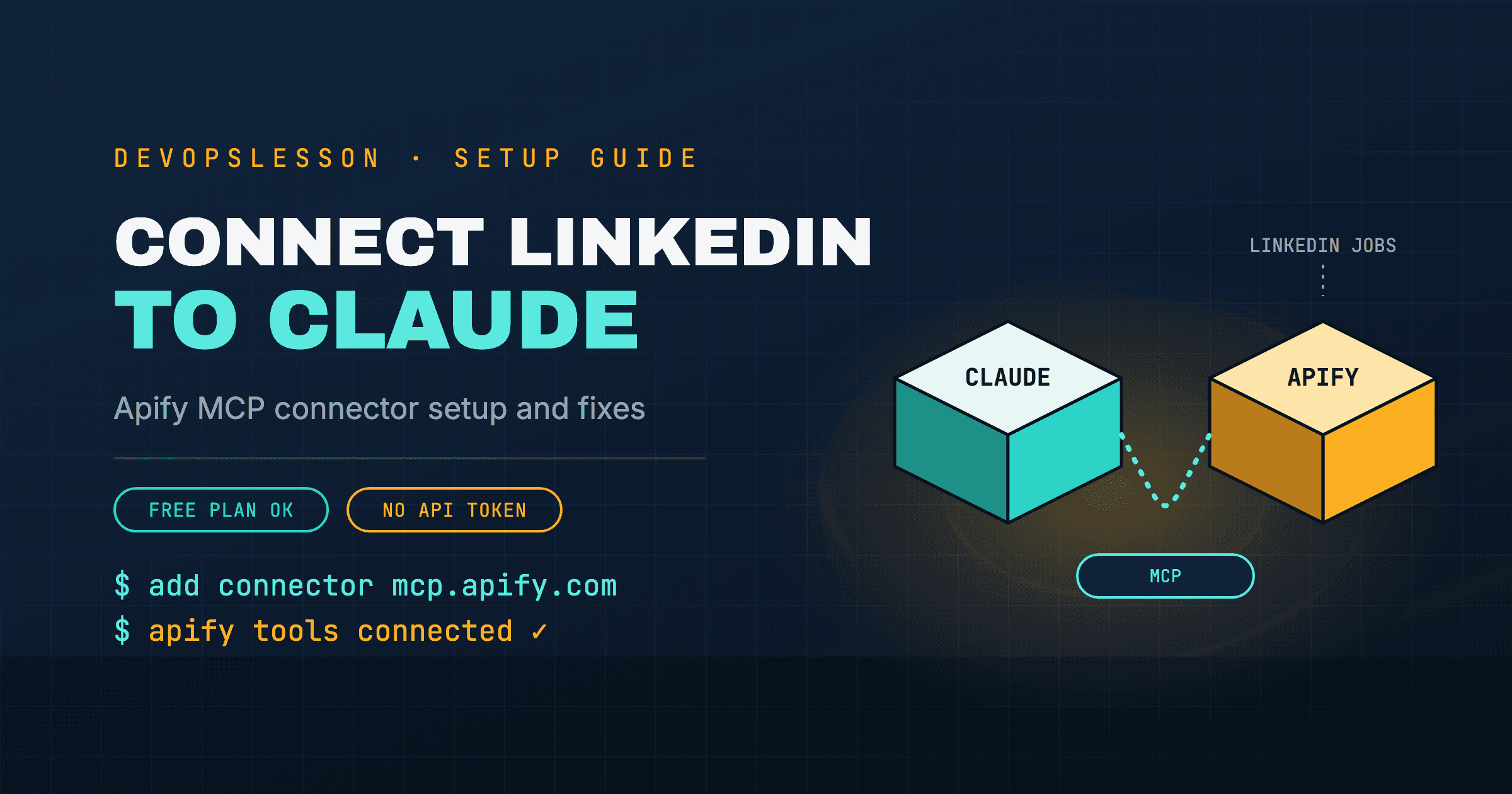
What does work is giving Claude a connector that runs a scraper for it. The common one is Apify: Claude sends the search, an Apify Actor fetches the results, and Claude gets back structured data it can filter, score and turn into a spreadsheet. That is the setup behind How to Use Claude to Find Jobs.
Whether you should is a separate question, and the answer depends a lot on what you are scraping.
Why Claude cannot do it on its own
Claude reaches the web through tools: web search, fetching a page, or a connector you add. None of the built-in ones are built for LinkedIn:
- Web search returns what a search engine has indexed, which for LinkedIn is a thin slice of public pages, often out of date.
- Fetching a page makes a plain HTTP request. LinkedIn serves logged-out visitors a sign-in wall or a stripped-down page, and it rate-limits anything that looks automated.
- There is no official LinkedIn connector. LinkedIn keeps its APIs behind a closed partner program, so nothing in Claude's connector directory reads LinkedIn job search on LinkedIn's behalf. Some third-party connectors in the directory publish posts to your LinkedIn page, but they cannot search jobs.
So "how do I get Claude to scrape LinkedIn" really means "which tool do I hand Claude so it can."
What actually works: the Apify connector
Apify is a marketplace of scrapers, called Actors, with an MCP server that Claude can use as a connector. Once it is connected:
- You ask Claude for, say, DevOps jobs in Toronto from the last 24 hours.
- Claude picks a LinkedIn jobs Actor and runs it with those filters.
- The Actor reads LinkedIn's public job search, the same listings anyone can see logged out, and returns rows: title, company, location, posted date, link.
- Claude works with those rows: removes duplicates, scores them against your resume, builds an Excel file.
Setup takes about five minutes. The step-by-step, including the free-plan limit and common errors, is in How to Connect LinkedIn to Claude.
Two things to know about the Actors themselves:
- They are community-built. Most LinkedIn Actors on Apify are published by independent developers, not by Apify or LinkedIn. Price per result, reliability and filters vary a lot, so check an Actor's run count, reviews and last update before trusting it.
- "No login" matters. Prefer Actors that read only the public job search and never ask for your LinkedIn credentials or cookies. Those cannot get your account restricted, because they never touch it.
What LinkedIn's terms say
LinkedIn's User Agreement prohibits scraping or copying its site through automated means. That is not theoretical: in the long-running hiQ Labs v. LinkedIn case, a federal court ruled in late 2022 that hiQ had breached that agreement, and hiQ settled, agreeing to stop scraping and delete the data it had collected.
The same case also shows the nuance. Earlier rulings found that scraping publicly accessible pages was unlikely to be "unauthorized access" under the US anti-hacking law (the CFAA). The legal risk that remained was contract: hiQ had a LinkedIn account and had agreed to the terms.
In practice the risk depends on what you do:
| What you scrape | Risk | Why |
|---|---|---|
| A few dozen public job postings a day, for your own applications | Low, but still against LinkedIn's terms | Public data, small volume, no account involved |
| Job postings at scale to resell or republish | High | Commercial use of LinkedIn's content is exactly what the terms target |
| Member profiles (names, work history, contact details) | Highest | Personal data, so privacy law such as GDPR applies on top of the terms |
| Anything through your own logged-in account | Account risk | LinkedIn can restrict the account it sees automating |
This is a general overview, not legal advice. Rules differ by country, and if you are building anything commercial, talk to a lawyer.
The safer way to use Claude for LinkedIn jobs
If the goal is finding and applying for jobs, you can get nearly all of the value with very little of the risk:
- Scrape job postings, not people. You need the posting and its link, not the recruiter's profile.
- Keep the volume personal. 20 to 50 fresh postings a day is a job search. Ten thousand is a dataset.
- Use logged-out Actors only. Never paste your LinkedIn password or session cookie into an Actor.
- Apply on LinkedIn or the company site yourself. Treat Claude's spreadsheet as a shortlist, and open each link to apply. That also catches postings that have already closed.
- Use the other sources too. Many companies list the same roles on their own careers pages and on job boards with public feeds or APIs, which carry none of these questions.
Where to go next
- 15 Claude Prompts for Job Search with Apify: ready-made prompts that keep the scrape small and the results useful.
- How to Automate Job Applications with Claude: why auto-applying is a bad trade, and what to automate instead.
- How to Use Claude to Find Jobs: the full workflow, from fetching postings to mock interviews.
Frequently asked questions
Can Claude scrape LinkedIn by itself?
No. Claude's web search and fetch tools do not log in to LinkedIn, and LinkedIn blocks most automated access to its pages. To pull LinkedIn data into Claude you need a connector, such as the Apify MCP server, that runs a scraper on Claude's behalf.
Is it legal to scrape LinkedIn with Claude?
It depends on what you scrape, how, and where you live. LinkedIn's User Agreement prohibits scraping, and a US court enforced that clause against hiQ Labs in 2022. Fetching a few public job postings for your own job search is much lower risk than collecting profiles, but it is still against LinkedIn's terms. This is not legal advice.
Can Claude scrape LinkedIn profiles?
Some Apify Actors advertise profile scraping, but it is the riskiest use: it involves personal data, which brings privacy law such as GDPR into play as well as LinkedIn's terms. For a job search you do not need profile data, so leave it out.
Can my LinkedIn account get banned for this?
Scrapers that log in with your own LinkedIn session or cookies put that account at risk, because LinkedIn can see the automated activity. Actors that read only the logged-out public job search do not use your account at all. Never give a scraper your LinkedIn password or session cookie.
Vishvesh Patel is a DevOps engineer who writes hands-on guides on Docker, Kubernetes, Terraform, CI/CD, AWS, and Linux. He builds the tutorials, roadmaps, and browser playgrounds at DevOpsLesson to help engineers go from beginner to job-ready.